Prof. Dr. Kasem Zaki
News
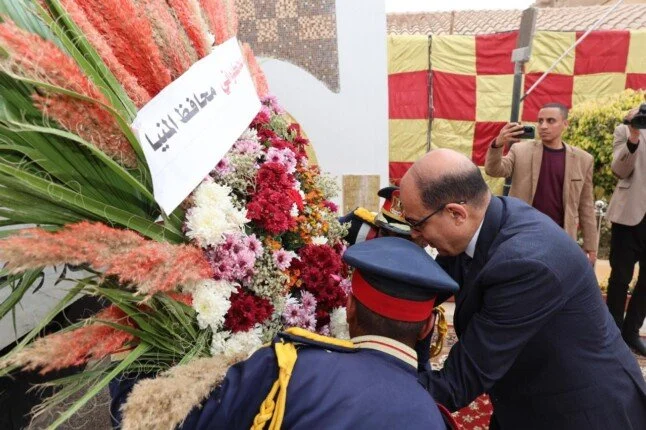
In every Egyptian governorate, there is a national day that encapsulates a grand saga: a moment of transformation from “daily living” to “national consciousness,” and from silent grievances to actions that leave an indelible mark on the country’s history. As for El-Minia National Day observed on March ۱۸th each year it is not merely a celebratory anniversary. Rather, it is an annual invocation of one of the fiercest and boldest chapters of the ۱۹۱۹ Revolution in Upper Egypt: The Deir Mawas Epic. This event culminated in a direct confrontation with British occupation forces, followed by military trials and widespread executions, ultimately becoming a symbol of the resilience and defiance of El-Minia’s people.
Multiple official and documentary references confirm that March ۱۸th is El-Minia’s National Day because of its association with the events in Deir Mawas during the ۱۹۱۹ Revolution. Confrontations ignited in the Deir Mawas district and the surrounding Mallawi area, and El-Minia adopted this date as a symbol of its sons’ sacrifices against the occupation. The State Information Service (SIS) notes that March ۱۸th is linked to an attack on a train carrying British personnel (including a prison official) within the Deir Mawas/Mallawi jurisdiction. However, the significance of this day lies not in a “number” on the calendar, but in its meaning: that El-Minia with its cities and villages was at the heart of the ۱۹۱۹ Revolution, proving that the spirit of resistance was not exclusive to the capital; Upper Egypt, at that pivotal moment, forced itself onto the map of the struggle.
When the ۱۹۱۹ Revolution broke out, Egypt had just emerged from the years of World War I, which brought severe economic and social pressures on the countryside: resource depletion, control over transportation and crops, and an occupation enforcing its authority through military and administrative might. Following the decision to exile Saad Zaghloul and the Wafd leaders on March ۸, ۱۹۱۹, the revolution rapidly expanded from urban protests to rural fury targeting railway lines the vital artery of British control over movement, troops, and communication. Here, El-Minia stretching along the Nile Valley with the railway as its vital spine found itself at a “pivot point”: if this pivot shook, the occupation’s ability to move within Upper Egypt would collapse.
In popular and journalistic memory, the Deir Mawas events are known as the “Epic of Blood and Honey.” Many accounts link the name to the scene of blood mingling on the tracks with local products (such as black honey/molasses) that were being transported near the incident, forming a title that encapsulates the brutality and the “authentic local” nature of the resistance. The details of the incident as told by Egyptian sources revolve around a train arriving from the south carrying a group of British military personnel, headed by the British Inspector of Prisons, nicknamed “Bob.” When the train stopped at Deir Mawas station, friction escalated into a confrontation, eventually leading to a clash that resulted in the death of “Bob” and several soldiers. This event stood as one of the most intense clashes of the revolution in Upper Egypt. Historian Abdel Rahman al-Rafai described the events in profound terms, considering them among the most violent incidents of the ۱۹۱۹ Revolution, highlighting the significance of civilians standing up to occupation forces.
Great revolutions are measured not only by the moment of clash but also by the authority’s subsequent reaction. After the Deir Mawas events, military trials and retaliatory measures followed. Journalistic sources state that the sentences included the execution of ۳۴ revolutionaries including Dr. Khalil Abu Zeid, who is presented in narratives as a prominent leader of the movement in Deir Mawas alongside prison sentences and fines for others. Conversely, these executions themselves became part of the National Day’s meaning: El-Minia does not celebrate blood, but the sacrifices of those who paid for freedom with their lives. From a local memory perspective, March ۱۸th is no longer just the anniversary of an “incident”; it has become a symbol of the people’s right to tell their history from within, ensuring their martyrs’ names are etched in public consciousness, not just in the margins of books.
Because it revealed two major truths:
- The Rural Capacity for Rapid Organization: Controlling a train station and facing an armed force is not a purely random act; it is an expression of accumulated anger, the presence of local/symbolic leadership, and a collective sense that transport lines are “lines of sovereignty.”
- Transition from “Protest” to “Disrupting Occupation Tools”: Occupation relies on movement, and the train is one of its most important tools. When the train itself becomes a battlefield, it means the revolution has entered a zone of maximum danger for any occupying power.
National Day celebrations usually combine two pillars:
- National Memory: Seminars, official speeches, visits to symbolic sites, and teaching the story of Deir Mawas and its martyrs in schools and local media.
- Development and Achievements: Governorates often use their national days to announce projects, inaugurations, or display the harvest of public work, attempting to link the “memory of struggle” with the “project of the future.” Memorials linked to the event exist within the Deir Mawas/Railway station vicinity, reflecting a desire to anchor memory in the place itself, not just in books.
El-Minia is a governorate with multi-layered “historical weight”: Pharaonic (Tell el-Amarna, Beni Hasan, Tuna el-Gebel), Coptic/Islamic, and Modern National. However, its National Day focuses on the modern layer of identity: the El-Minia that was on the firing line during the founding moment of modern Egyptian national consciousness. Thus, March ۱۸th remains an annual message to new generations:
- That patriotism is not a slogan found in Cairo alone.
- That Upper Egypt—despite the stereotypes that sometimes wrong itwas at the forefront when the nation needed courage.
- That a “National Day” is not a song in a morning queue, but a question: What are we doing today to be faithful to the blood of yesterday?
Because national memory, if not told well, turns into a “suspended history” that changes nothing. Writing about El-Minia’s National Day is an opportunity to re-present the ۱۹۱۹ Revolution from a deep local perspective: How did the people of El-Minia live the revolution? How did they pay its price? And how did the place itself witness a moment of confronting an empire with the power of the people? In an era where “trends” compete for consciousness, restoring stories like Deir Mawas is not just nostalgia, but a defense of meaning: the meaning of El-Minia like every governorate having a grand story worthy of it, teaching its children that dignity is crafted in the details, and that history is not written by the powerful alone, but also by the farmers when they decide the train shall not pass as the occupier wishes.
Source: Sawt El-Minia Website